When parents tour Casa Dei Bambini Montessori, one of the most common questions we hear is: “How can I replicate this learning environment at home without buying expensive wooden toys?”
The wonderful secret of Montessori education is that it isn’t about specialized toys, it’s about mindset and engagement. In the classroom, children participate in what Dr. Maria Montessori called “Practical Life” exercises. These real-world tasks build motor skills, concentration, executive function, and a deep sense of independence.
You don’t need a classroom to nurture these qualities. Here is how you can transform daily household routines into rich learning experiences for your child right here at home.
1. Create a Low-Level Prepared Environment
In a Montessori classroom, everything is scaled to the child’s height. At home, you can easily adapt key areas to give your toddler or primary child autonomy:
-
Entryway Station: Place a low hook for their coat and a basket for their shoes near the front door. Having a designated spot makes leaving the house for a trip to Phillips Park Zoo or the Scitech Hands-On Museum much smoother.
-
Accessible Snacks: Dedicate a low shelf in the refrigerator or pantry with healthy, pre-apportioned snacks and a small pitcher of water with child-sized cups.
2. Turn Chores into Practical Life Mastery
Toddlers and young children have a natural inner desire to participate in real work. Rather than trying to keep them busy while you clean, invite them to help:
-
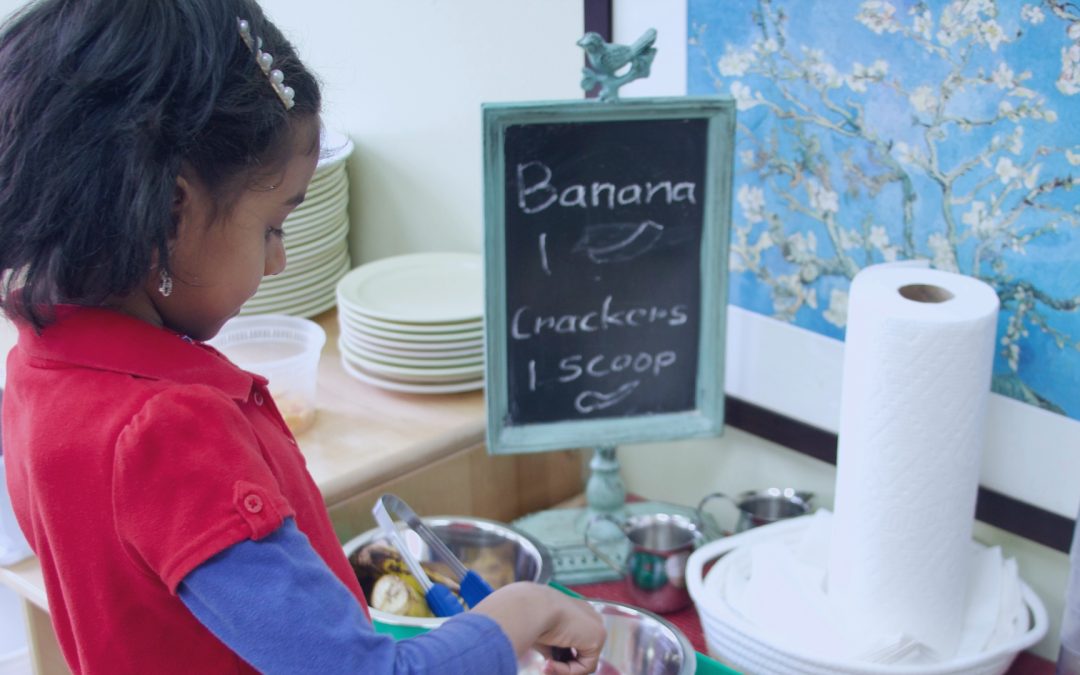
Slicing & Spreading: Using a child-safe nylon knife, toddlers can slice bananas or spread butter on toast.
-
Watering Plants: A tiny watering can allows them to care for houseplants, teaching cause-and-effect as well as empathy for living things.
-
Matching Laundry: Sorting socks by color and pattern builds essential visual discrimination skills that lay the foundation for early math and reading.
3. Cultivate Executive Function Through Routine
Montessori emphasizes multi-step cycles: Choose work Perform work Return work to its place.
You can reinforce this cycle at home using visual daily schedules. Encourage your child to complete the entire loop, putting toys back on low, uncluttered shelves before moving on to the next activity.
Montessori Tip: Instead of saying “Good job!”, try descriptive encouragement: “I noticed how carefully you wiped up that spill all by yourself.” This builds intrinsic motivation rather than a reliance on external praise.
Connecting Home and School
When home and school align, children thrive with confidence and emotional security. At Casa Dei Bambini, our Practical Life area is the cornerstone of our Infant, Toddler, and Primary classrooms, laying the groundwork for academic learning in math, language, and science.
Want to see how our prepared environments foster lifelong independence? Schedule a tour of our Aurora campus today to observe our classrooms in action.